Sunday, October 30, 2016

Weekly Web Wonder 9: Inquiry-Based Instruction. Whats the Hype About?

Image result for inquiry based funny

Friday in #AEE412, we were introduced to Inquiry Based learning and given the hint that this weekly web wonder is very important. I completed my readings, and spent the afternoon with many thoughts on the subject racing through my head. I know I could easily write a blog that outlined the basic cycle of inquiry, but that didn't seem right. I know that inquiry involves students creating their own knowledge through interest, but it is more than simple problem-solving. I also know that, if done correctly, both students and teachers will benefit. This is an idea that was rarely used on me as a student and, as I found out, is relatively new to education. All things considered, you can understand why I feel like I'm dealing with something big here.

On Friday I recognized that we are all sort of learning about inquiry using inquiry. Therefore I hope I can contribute these ideas to our conversation:
(Note: To try and further my own ideas, I have been trying to get into Pinterest. Seeing a good situation, I used it to find the following:)

Check out this Edutopia Article. I like how the article broke down the idea into simple language. Educators have to battle students "dunno" when asked what they want to know. What we are doing with inquiry is trying to recreate the "whaa!?" feeling when we see something that peaks our interest. Also remember: "I think one of the reasons why the whole world seems to be losing its mind over the Broadway production of Hamilton is because it presents a fresh take on a story we’ve all heard before. The power of learning something new is undeniable."

From our reading, we can implement it this way: 
1.starting the inquiry process; 
2.promoting student dialog; 
3.transitioning between small groups and classroom discussions; 
4.intervening to clear misconceptions or develop students’ understanding of content material; 5.modeling scientific procedures and attitudes; and, 
6.utilizing student experiences to create new content knowledge.

When implementing, remember:

Provide the exploration opportunity in an environment of safety and trust and watch the evolution of problem solving.  Little adult input needed..... it's amazing how children love to learn but adults sabatoge it every day.


Inquiry based learning will not work in all situations for all subjects. It is also hard to get students to buy in to the idea. But when we can, it is an awesome power tool to keep in our teacher toolbox to further 21st century skills and promote student independence.


Monday, October 24, 2016

Weekly Web Wonder 8: Differentiated Instruction

Diferentiated. Differensiated. Differentiated  Instruction. As intimidating as it is to spell, the idea of it can scare new teachers just as much. My first thought was this would relate to students IEP's, however that is more based around individualized instruction. Individualized instruction works around setting specific goals for a student based on ability(?). Differentiated instruction is how you respond to your students and class as a whole, specifically in their readiness, interests, and learning preferences, while keeping the same rigor and expected learning goals.

Readiness: How much do they already know? You can not expect your ag mech class to diagnose problems with their small gas engines if they do not know the 4 strokes. However, your next period ag mech class might be able to rebuild engines in their sleep. This involves assessment of prior knowledge and may often lead to a "ok back it up" moment. I often hear high school and college students alike complain about being overwhelmed by content, or that "they never taught me this and expect me to know it". I wish to avoid all such comments in my future students

Interests: Of course, this relates to interest approach. How can we link what we are doing to prior knowledge and experiences? If we can do so, we create a feeling of "want to learn" rather than "have to learn".

Learning preferences: In mechanics, I prefer to learn hands-on with a coach by my side. Others prefer to learn by reading the manual. Every student prefers a different way to "..acquire, process and work with information. Learning preferences are influenced by gender, culture, the classroom environment, learning styles and multiple intelligences."(1) How can we teach to all these different styles?

I want to note that differentiated instruction requires constant formative assessment (shout out to last blog!). It is difficult to plan differentiated instruction far in advance. I know I will eventually end up re-planning future lessons based on my assessment of teaching that day, but hopefully I will be able to look back and remember this blog and why it is all worth it.


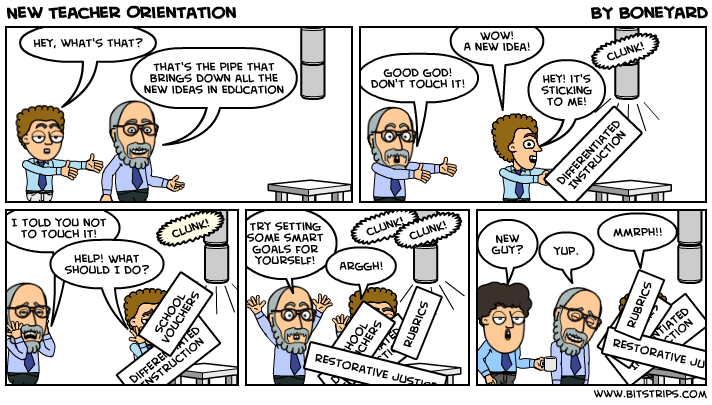
To end on a funny note...
Image result for differentiated instruction
When I saw this strip, I could not pass up including it. In #AEE412 we have all these ideas coming down the pipeline and at sometimes it feels overwhelming. I feel our cohort gaining confidence in our ability to apply everything that has stuck with us. Here's to the week ahead!

(1) http://www.edugains.ca/resourcesDI/Brochures/DIBrochureOct08.pdf

Sunday, October 9, 2016

Weekly Web Wonder 7: Tackling Assessment


Assessment Pre-Thoughts

In my #TeachAg journey, no subject makes me more uncomfortable than assessment. I struggle to think of a way that we can asses what students know in an objective way, while keeping in mind individual talents and abilities and needs, while still grading according to district policy. I know that pre-assessment is a valuable part of the process because it establishes a baseline. Therefore, I am writing this part of my blog before I start my readings in order to capture beginning thoughts. Overall, when I hear someone say assessment, I think of the two pictures below.

Image result for daniel tosh test taking
Sadly, I feel comedian Daniel Tosh's comments are
all to common in our school system.
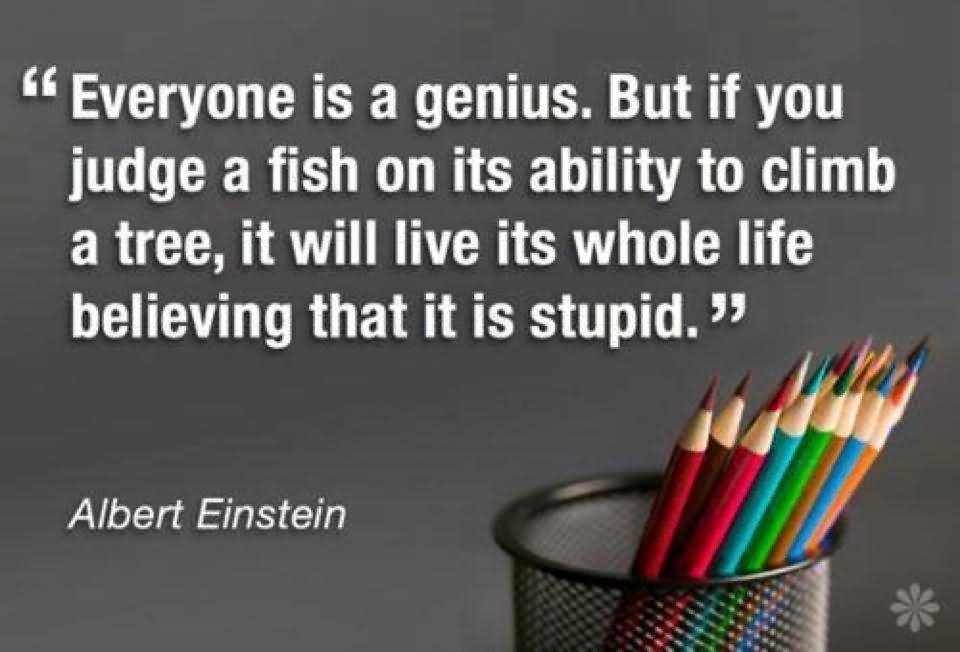
Image result for if you judge a fish by
Although it is commonly used quote, it's idea is very important
to keep in mind as we fight the idea presented in the first photo.
I realize that exams are not going away, and I will give many in my time as an educator. Where I can make a difference is in the way that I write questions, and incorporate other assessment strategies.

Reading Reflections

I know that assessment does not directly equal grades, but that is the area that concerns me the most. After reading, here are a few points that stick out to me that I feel may help address my concern above:
  1. Remember the difference between summative and formative assessments. Summative assessments are our traditional tests and quizzes, often cumulative, and at the end of a topic. They can also include final projects, and. are the basis for grades. Formative assessments are where students get input and feedback from others. We can do that may different ways and on a constant basis. Make sure to include both ways. Is there a way to incorporate grades into formative assessments, or is it simply a way to build scaffolding around a students learning experience to help them perform when grades are at stake?
  2.  "Measuring is the third part in a five part process".
    • Set outcomes
    • Identify where outcomes are addressed
    • Measure
    • Revise
    • Re-measure
  3. Good test questions inspire though on the subject, not just regurgitation of a fact. Use bloom's taxonomy!
  4. Rubrics are a tool to keep assignment grading objective, and expectations clear to students.
  5. On my note of "bad test takers": Vary your assessment strategies and allow students to show you all of their skills. When it comes to assessing exceptional students, remember to view the IEP to see where accommodation or modification my be necessary. Our biggest challenge here is how do you weigh the grades of students who have received alternative assessments? A 100% grade on one does not equal a 100% on the other. 
  6. "High-quality grading and reporting systems distinguish three types of learning criteria related to standards":
    • Product Criteria
    • Process Criteria
    • Progress Criteria
  7. Grades should never be assigned as a "feel good" move. Always keep things objective. If students struggle, re-evaluate your learning objectives for them.
I feel like the more I know, the more questions I have. Nevertheless, here is my final thought for the blog. Remember that students will inevitably get good and bad grades in your class no matter how you write questions, vary instruction and assessment strategies, and write objectives. It is our job to give each student the best opportunity for success (they can take it or leave it) and then keep grades as objective as possible. 


Sunday, October 2, 2016

Weekly Web Wonder 6: Problem Solving and Project Based Learning

Problem Solving

Problem solving is one of the most basic skills that students should receive from education. Just think of what everyone from mechanics to engineers do on a daily basis in their careers. I will admit that I have taken problem solving for granted in the past. It was just something you do, everyone should know how work though a problem. But these readings helped take me back to my math class freshman year. Our whole class did well on quizzes where the problems were purely math based, but we struggled on the exams where we needed to apply the concepts to real life situations. We were asked to problem solve, but couldn't because we were never taught.

Image result for problem solving strategiesThe need for problem solving is the first thing Jamie Kirkley identifies in her technical paper Principals for Teaching Problem Solving. She points out how fast ideas change in modern science. We can not educate our students with current knowledge and expect them to be good through their careers. We need to teach them how to be life long learners and adapt to changes. We can do that by teaching the process of problem solving:

1) Identify the problem
2) Define the problem through thinking about it and sorting out the relevant information
3) Explore solutions through looking at alternatives, brainstorming, and checking out different points of view
4) Act on the strategies
5) Look back and evaluate the effects of your activity

Project Based Learning

Assigned projects themselves are not considered project based learning. We have all been assigned projects that we feel were simply "busy work". That defeats the entire purpose. Our readings highlight 8 essentials to project based learning. They are:
1) Significant Content
2) A need to Know 
3) A Driving Question
4) Student Voice and Choice
5) 21st Century Skills
6) Inquiry and Innovation
7) Feedback and Revision
8) Publicly Presented Product

The part I was least comfortable with was the 21st century skills. To clarify this, I found the graphic below. It is a good idea to keep these in mind with every lesson we write.

Image result for 21st century skills
I'm looking forward to diving into project based learning by writing my lab lesson this week and presenting it next week!


Sunday, September 25, 2016

Unloading the Trailer: Lab 3, Interest Approach

My performance in lab this week was not quite up to where I would hope it would be. Nevertheless I believe I continued to be strong in a few areas of delivery, and showed improvement in others. Here are my gems and ops as I unload the trailer to prepare for next week.

Gems

  • As Cahill pointed out on Edthena, my lesson had lots of variability. I went from Google searching, to a video, to a powerpoint in the first ten minutes. I don't feel like it was too much too fast either. It all flowed together. The challenge would then be keeping the variability going as the powerpoint starts to get pretty heavy. 
  • The daily Google. This is a strategy I remember hearing from an ag teacher many years ago, and it has stuck with me to this day. The idea is that you start by having students google search a basic question, one so basic they may have never considered it before, and have them record and share their findings. It is almost like a mini interest approach in it's self. It is designed to spark follow up questions that will relate to the day's content. I had some mixed feedback about it, but I believe it will go smoother if I introduce it better at the beginning of the year, and make it a regular part of class.
  • Including vocab. I included essential vocab at the beginning of the lesson as a way to foreshadow the content. Vocab on the board is a common practice at Central Columbia. My peers liked this and thought it made me come across as more knowledgeable, which is always nice.
  • My peers and I agreed that I had a good strategy for Snyder when he started to doze off in class. I used proximity to make him alert, and then asked him a question, all without missing a beat.

Opps

  • My interest approach in general was a little "ehh". I feel like these kind of things are supposed to come to you, highlight Dave Burgess when he talked about buying golf balls in the middle of the night after a cool idea laying in bed. This one came to me on Monday when a friend shared a Red Greene video on facebook. I took it and ran with it. There was mix of positive and negative feedback on the video. I feel it would have gone better if I would have scaffold better questions and content around it.
  • I did not make sure technology worked before designing the lesson and had to adapt day-of.
  • For some reason I decided not to correct Miranda even thought I saw her on her phone during the video. Perhaps I didn't want to interrupt the video? I should have taken action here.
  • I need to be more creative with how I ask questions and accept students responses.This was also peer-mentioned. I believe class this week will help clear this up.
  • I was a little under the weather, but it was noted this week and last that I should bring the energy up. That is something to continue improving on. 

Weekly Web Wonder 5: Asking Questions and Letting Students Know They Matter

Image result for questions

Questions


Questions are the key to education. There is no other aspect that we can control more, or use to have a greater influence. Most of the time we think of questions as an assessment of learning, but we can't overlook how important they are to guiding learning. Questions will naturally happen in the classroom, but if we question ourselves on how we ask questions (see what I did there?) we can start asking at higher levels and some pretty cool stuff can happen.


Here are a few ideas (according to James E. Dyer) that I want to document because I feel are important to keep in mind:


  • There are low and high levels of questions, and both are important in their own right. Low level questions Evaluate comprehension/preparation, diagnose strengths and weaknesses, and Review content. Higher levels of questions encourage deep/critical thinking and discussion, solve problems, and stimulate self-directed learning. 
  • Questions can be open or closed
  • Wait time is a thing. It refers to how long you wait to solicit a response after asking. A good wait time is 3 seconds, but shouldn't be longer than 5-7 seconds. 
  • How you handle response to questions is just as much of a craft as what you ask. 
I know that asking the right questions is a matter of practice. After a while, we will be asking appropriate questions with little conscious effort. Nevertheless I still want to consciously improve this skill, specifically responding to answers correctly. (If you watch my labs, you will see I could use work on this). I will continue to dive into this and work on it with my peers and Mr. Brown.

Students Matter

Image result for hierarchy of needsWhile the first part of our weekly investment was important to developing my pedagogy, I feel the second part was equally important to developing my passion. More than any other piece of information my students will learn in class, I want them to know they matter. One of the main reasons I went into ag education over anything else is that ag teachers have such a unique opportunity to work with students as people as well as learners. I have had many good talks in this matter. One example is taken from a recent email with Mr. Brown. He said: "I had a class of 9th grade students today make a statement that said, Mr. Brown we wish all teachers were like you and Mr. Turner-teachers that get to know us as people not just students and that really care about what we do on a daily basis." 

This comes back to Maslow's Hierarchy of Needs. As the Ted Talks pointed out, if students feel like their ideas matter, they will create wonderful things! Also, this feeling of importance is more than a facade that we construct as a tool to achieve an end result. It has to be real! I know this because I experienced this as a high school student. 

My senior year, I had Mrs. Hyde for English. The classroom engagement was pretty average as far as English classes go, but I will always remember the custom poster she had at the front of her room. By this point, I knew I wanted to teach ag, so before I knew any of the theories behind it that I know now, I wrote it down and promised myself that I would have a similar one in my classroom one day. I will leave you with a similar copy below. Remember: we are more than simple teachers. We have the ability to make a positive difference in the lives of students by developing premier leadership, personal growth and career success each and every day while we instruct our curriculum to the future of the agricultural industry!

Image result for dear students


Sunday, September 18, 2016

Weekly Web Wonder 4: Writing Objectives and Grouping it Out

I believe I entered my weekly readings at a great time. Behind me, I have my first attempts at lesson plans and units. With me now I have the writing and execution of lesson plans for National Teach Ag! Day and FLC. In front of me I have countless more lessons to write. Relating to Primary level of interest #2, I see how these subjects will effect myself and others in the near future. Here are my take-aways and questions.

Writing Objectives

Displaying IMG_0017.PNG1) Objectives are more than a road map for you as the instructor to stay on topic. Providing objectives are also a way to decrease student's anxiety towards new information by allowing them to see how it connects. We as teachers need to balance the uncomfortable strain put on the mind needed for growth (shout out to Rider's blog) and leaving students feeling completely lost. Learning is a journey, not a "thrill of  not knowing what is next" type of adventure.
2) We can stretch student's cognitive processing (as eluded to above) by ensuring that write objectives, teach, and evaluate consistently at the same cognitive level. We can ensure that by carefully selecting the right action verb in our objectives. I love lists, and the list of verbs Whittingotn provided is seen to the right. I have seen lists like this before, but I will keep this particular one on file to help me in the future.

My clarifying question is: "How can we best measure the cognitive level of our students so that we can write the best objective to challenge them?"

Group Work

Image result for forming groups
I am a big fan of students working and learning together in groups. However, despite all the benefits, group work can fail when all students are not engaged and a few people end up carrying the group. Last semester I took a small group leadership class with Brad Olson. It gave me great context for how groups interact together, and Myers/Groseta provided great framework to back up what I learned. Just as some quick clarification:

In Brad's class we completed tasks in our own in-class groups. Our heterogeneous groups were assigned for us based on our own personality tests. I read that it is very important to take learner's skills into consideration. However you most often see groups formed by the "count off by 4" method. In Brad's class, much effort went into forming our groups and our groups were in place for the whole semester. How can we properly form groups if we want a heterogeneous mix, but are only in groups for a lesson or two or one project?

Final Thoughts
As we plan our lessons and units of instruction, we need to carefully consider our student's intelligence and cognitive levels. We need to make sure our objectives provide a road map that challenges them but does not make them feel lost. We also need to keep these things in mind when we assign, monitor, and evaluate group work.